
Criminal Cases in the Cayuga County Courts
Cayuga County does not place every criminal case in one court. Cayuga County Court, at 152 Genesee Street in Auburn, is the ordinary trial court for prosecuted felonies. Its clerk can confirm an indictment or case number, public status, appearances, copy procedures, and the route to a certificate of disposition. The court can be reached at 315-237-6450, extension 1. New York Supreme Court has broad original jurisdiction, but County Court is the local felony forum readers will most often need.
Auburn City Court, at 157 Genesee Street, handles misdemeanors and lesser offenses and conducts felony arraignments before transfer or grand-jury action. It is open weekdays from 8:00 a.m. to 4:00 p.m. and answers at 315-237-6420. Outside Auburn, a town or village justice court may own the first case file. That local file does not merge with the Auburn City Court file merely because both courts sit in Cayuga County.
Cayuga County Court Case Split
The few blocks between the main courts can hide a key records distinction. A felony may be arraigned at Auburn City Court, yet its indicted prosecution proceeds at Cayuga County Court. A misdemeanor generally stays with City Court or the town or village court that has jurisdiction. The charging paper, appearance notice, or arrest paperwork should name the first court. If the matter began outside Auburn, use the Unified Court System town and village court finder to identify the clerk and current contact details.
Ask which office holds the exact stage you need. The sheriff can supply an agency report or booking record, but it cannot certify a court result. The County Clerk also is not a universal criminal-docket counter. The clerk of the court of conviction issues the authoritative certificate of disposition. This document is the soundest way to confirm the final charge, plea or verdict, and sentence in one Cayuga County prosecution.
Note: A local arraignment record and a later felony case can be related without being held at the same Cayuga County counter.
How to Search Case Records
A productive Cayuga County criminal case search begins with a court name or case identifier. Published eCourts and WebCriminal coverage is not comprehensive for Cayuga County. Treat those tools as leads, then verify the public file with the originating clerk. The statewide OCA Criminal History Record Search, or CHRS, is a separate exact-name-and-date-of-birth product. It costs $95 per name and birth date and is not a certified disposition.
- Read the appearance ticket, accusatory instrument, or other case paper for the named court and docket, indictment, or SCI number.
- Use the court finder or call the named clerk. Confirm the number, public status, next appearance, and the office's copy process.
- Check eCourts services as a lead, but do not assume a blank result means no Cayuga County case exists.
- Order OCA CHRS when a statewide exact-match name and birth-date report fits the question. Search each alias separately.
- Request docket papers or a certificate of disposition from the actual clerk when the full or certified outcome matters.
| Field or Control | Type | Use | Cayuga County Note |
|---|---|---|---|
| Search mode | Tabs | Choose one route | Defendant, case identifier, or court calendar |
| Last and first name | Text | Name route | Spelling matters; confirm with the clerk |
| County | Dropdown | Optional filter | Select Cayuga when the dataset permits |
| Court | Dropdown | Optional filter | County, City, town, and village coverage can differ |
| Case, SCI, or indictment number | Text | Alternate route | Best key for a known prosecution |
| Calendar date | Date | Calendar route | Finds a scheduled public appearance |
Cayuga County CHRS Case Limits
CHRS reports public open or pending cases and convictions supplied by New York County, Supreme, City, Town, and Village courts. The search requires an exact full name and date of birth. Each alias and each different birth date is another $95 request. Online Direct Access requires an account. A mail request goes to the OCA Criminal History Record Search Unit, 25 Beaver Street, Room 940, New York, NY 10004, with a check or money order. Cash is not accepted for the mail route.
A no-record response has a narrow meaning. It says the exact search did not return a reportable CHRS entry. It does not prove that no arrest or case ever existed. CHRS omits sealed matters. It may also omit a case with no final disposition and no activity during the prior five years unless an open warrant exists. The report is not certified, so return to the Cayuga County court clerk for proof of the outcome.
The official eCourts page supplies context for the online services used in New York. The image below comes from that Unified Court System eCourts source.
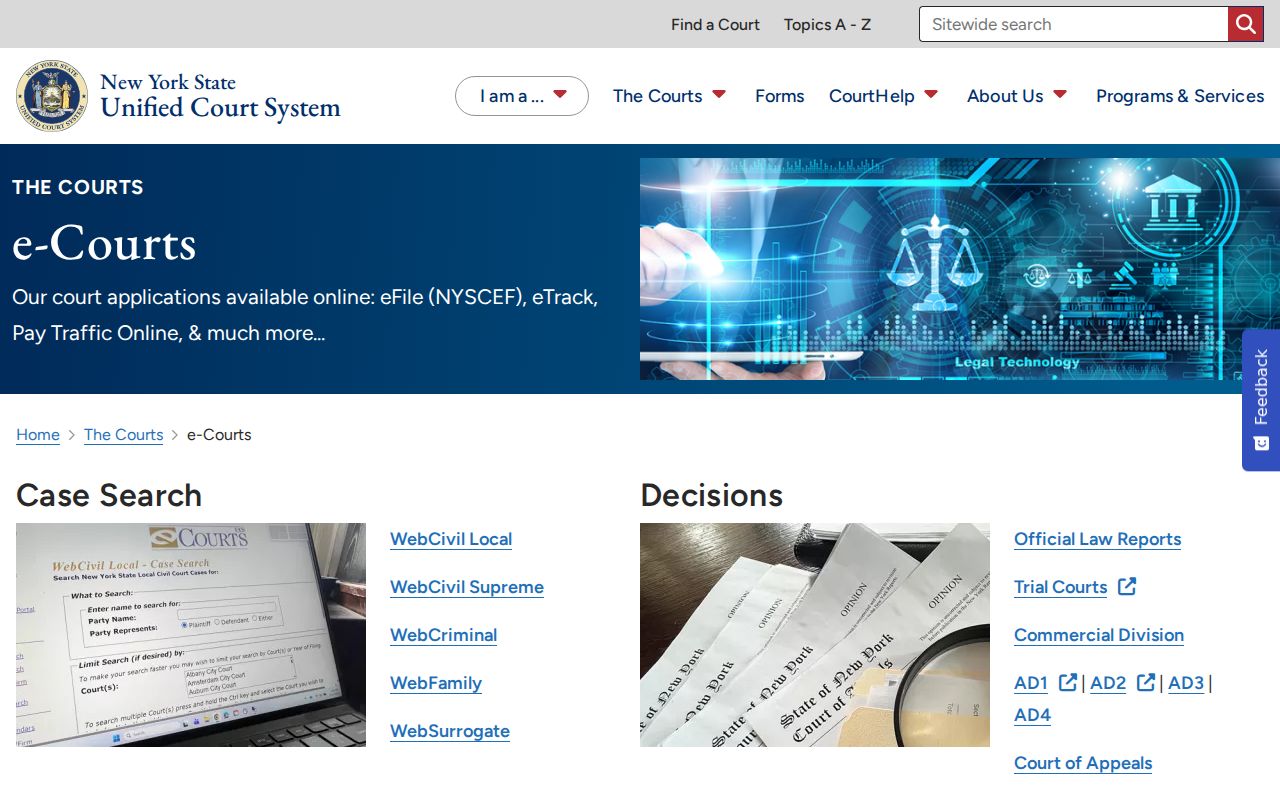
Its service list is a useful starting point, while the Cayuga County clerk remains the source for complete local papers and certified dispositions.
What the Case File Shows
A Cayuga County court file records the prosecution as it changes over time. It can show what the prosecutor filed, when the defendant was arraigned, which motions or hearings occurred, whether the case ended by plea or trial, and what sentence followed. These fields differ from jail intake charges, which reflect the accusation at booking. A public index may show only part of the file, while papers and certified results remain with the clerk.
| Case Number and Court | The docket, indictment, or SCI identifier and the Cayuga County court that owns the file. |
|---|---|
| Charging Document | The filed offense, statute, grade, counts, and accusatory or indictment paper. |
| Docket Entries | Arraignment, motions, hearings, plea, trial, warrant, stay, and other public events. |
| Calendar Details | Appearance date, court part, purpose, and judge when publicly displayed. |
| Disposition | Conviction, dismissal, acquittal, plea result, or other lawful public outcome. |
| Sentence | Incarceration, probation, fine, conditional discharge, restitution, or other reported terms. |
| Access Limits | Sealed, youthful-offender, juvenile, victim, and other sensitive data may be omitted or restricted. |
Older Cayuga County Court Cases
An absent online result may point to age or storage, not to a missing case. Ask the originating clerk whether the file is off site or requires archive retrieval. Cayuga County preserves Oyer and Terminer Court minutes dating from 1684 through 1895. That predecessor court called grand juries, tried indictments, and dealt with prisoners held on criminal charges. It was absorbed into Supreme Court's Criminal Part in 1896.
The county archive description shows why historical research needs a different tool from CHRS. Archive minutes can document an old proceeding, but they are not a modern name-and-birth-date report. Give staff a full name, likely year range, town, and any known court reference. For a recent case that is merely absent online, start with the modern court clerk rather than the archive.
Stages of a Criminal Case
A Cayuga County case file grows by event. Police paperwork may explain the arrest, but the filed court charge begins the prosecution record. Arraignment advises the accused of the charge and addresses release conditions. Pretrial entries may include counsel appearances, motions, discovery disputes, conferences, and hearings. A plea or trial resolves the charge, followed by a disposition and, when required, sentencing.
Case flow: Charges Filed › Arraignment › Pretrial › Plea or Trial › Disposition › Sentencing
Not every Cayuga County case uses every stage. A charge may be dismissed, reduced, or covered by another count. A felony can start in a local criminal court and later move to County Court after indictment. Follow docket dates and court names, not just the first charge shown in an arrest or booking record.
Cayuga County Treatment Court Records
Cayuga County has two named criminal drug treatment courts. One operates in Cayuga County Court at 152 Genesee Street, and one operates through Auburn City Court at 157 Genesee Street. Auburn City Court also has a domestic-violence court part. The state treatment-court directory confirms the separate locations and contact routes.
These programs still generate court entries, orders, and dispositions, but treatment details are not automatically open merely because the main docket is public. Ask the clerk for the public case record and expect protected clinical, victim, or program data to be withheld or redacted. The correct certificate of disposition still comes from the court of conviction. Program participation should not be inferred from a bare arrest record.
Note: Public docket access does not make protected treatment or victim information part of an unrestricted Cayuga County case file.
Access & Restrictions
New York courts are not executive agencies covered by FOIL in the same way as police or the sheriff. Request Cayuga County case papers from the court clerk under judiciary and court rules. Judiciary Law §255 directs clerks to search and certify records in their custody when access is lawful and required fees are paid. Use the Criminal Procedure Law to understand the sealing rules, not as a substitute for asking the clerk whether a specific file is public.
CPL 160.50 covers sealing after a favorable termination. CPL 160.55 addresses specified outcomes, while CPL 160.59 and CPL 160.57 govern forms of conviction sealing and Clean Slate relief. Youthful-offender records are confidential under CPL 720.35. Juvenile, grand-jury, sensitive victim, medical, and active protected information may also be closed or redacted. A blank online screen can therefore reflect lawful restriction rather than a search failure.
Cayuga County Case Charge Changes
Three records can show three different charge sets without any one of them being fraudulent. The booking record captures the accusations at jail intake. The prosecutor may file different charges after review. A plea, dismissal, acquittal, or trial verdict can change the final set again. Repository systems then rely on correct matching and timely disposition reporting. That is why a booking line should never be used as the final Cayuga County case result.
When records conflict, match the arrest date and agency to the correct docket, then obtain the court's certificate of disposition. A person reviewing their own DCJS record can compare each arrest cycle with that certificate and use the DCJS Record Review correction process if a disposition is wrong or missing. For a fuller explanation of the record before charges were filed, see the county's arrest history process.