
How to Check Criminal History in Auburn
Begin with the Auburn event, not a broad name query. Auburn has four main custodians, and each answers a different part of the Auburn record. The Auburn police report describes the call and arrest. The Auburn-linked jail file documents intake and release. The Auburn court docket follows the charge, plea, orders, and outcome. A DCJS personal Record Review connects fingerprint-supported Auburn events reported across New York, but only the person named in that record may order it.
- Ask the Auburn Police Records Bureau for the city report or local check.
- Give the report number, date, place, and names when requesting a copy.
- Contact Auburn City Court for the city case, calendar, or disposition.
- Call Cayuga County Jail or County Court when custody or an indicted felony is involved.
- Use OCA CHRS for a public statewide court-name search or DCJS Record Review for your own fingerprint record.
The broader Cayuga County criminal history overview explains county and state channels in more depth. For one Auburn event, direct office checks are often more precise than a statewide result.
Auburn Police Records on North Street
The Auburn Police Records Bureau is at 46 North Street, Auburn, NY 13021. Its counter is open weekdays from 7:00 a.m. to 3:00 p.m. Call 315-255-4723 or fax 315-255-0022. Two full-time staff scan and archive documents, manage case reports, enter police reports, maintain warrant entries, serve public-record requests, and submit monthly crime reports to DCJS.
That Auburn records work makes the bureau the first stop for an APD incident. It does not make Auburn Police the keeper of sheriff, State Police, jail, or court records. Metered parking is available on Market Street across from Cayuga/Seneca ARC. The practical point for an Auburn request is simple: confirm that Auburn Police handled the event before asking its staff to search.
The Auburn Police Department
APD accepts focused requests for existing records. A useful description states the incident or report number, approximate date and time, location, involved parties, and the document sought. It also gives requester contact details and a preferred format. The official Auburn Police FOIL form can be emailed to APD-Records@auburnny.gov or delivered to the bureau.
| Copies | $0.25 per page |
|---|---|
| Local check | $25 |
| Fingerprint service | $50 |
| Body-camera FOIL | $5 under two hours; $47.60 per hour over two hours |
| Payment | Cash or personal check; no credit cards |
An Auburn local check covers local holdings, not a complete New York rap sheet. Ask Auburn Records what its search includes before relying on the result. Auburn accident reports can also be reached through the online link on the bureau page.
Auburn Police Report Request Fields
An Auburn request works best when it lets staff identify one Auburn record without guessing. The form calls for a requester name, address, phone or email, a clear Auburn record description, delivery or inspection preference, signature, and date. An Auburn case number is valuable, but an exact date and location can still narrow the search when that number is unknown.
FOIL applies to APD as an Auburn city agency. It reaches records already kept by the Auburn department; it does not require staff to create an explanation or new report. Some Auburn material can be redacted or withheld for privacy, an active investigation, confidential sources, protected victims, juveniles, sealed matters, investigative methods, or safety. A partial Auburn response may therefore be lawful even when the underlying event is known.
Note: APD's five-business-day FOIL duty concerns acknowledgement, not a promise that every Auburn record will be produced within five days.
Arrests and Bookings in Auburn
APD creates its arrest and incident paperwork. If detention is required, the person is processed at Cayuga County Jail, 7445 County House Road, outside the downtown record corridor. Jail staff create a booking number, intake time, custody status, property record, classification, and release or bail entries. The sheriff's file can therefore answer custody questions that Auburn Police cannot.
Call the jail lobby at 315-253-2911 for recent Auburn custody information. Sheriff Records, at 315-253-1148, handles Auburn booking requests for sheriff-created documents that are not routinely released. There is no verified public Cayuga inmate-name portal or official Auburn arrest app in the research. A very new Auburn arrest may be known to the jail before it appears in an Auburn court index.
Auburn Municipal Court Records
Auburn City Court sits at 157 Genesee Street and is open weekdays from 8:00 a.m. to 4:00 p.m. The clerk can be reached at 315-237-6420 or by fax at 315-237-6421. The court hears misdemeanors and lesser criminal offenses. It also conducts felony arraignments and preliminary work before an indictment moves the prosecution to Cayuga County Court.
The official Auburn City Court source shows the court's address and role. The image below preserves that official source view rather than depicting any defendant or private record.
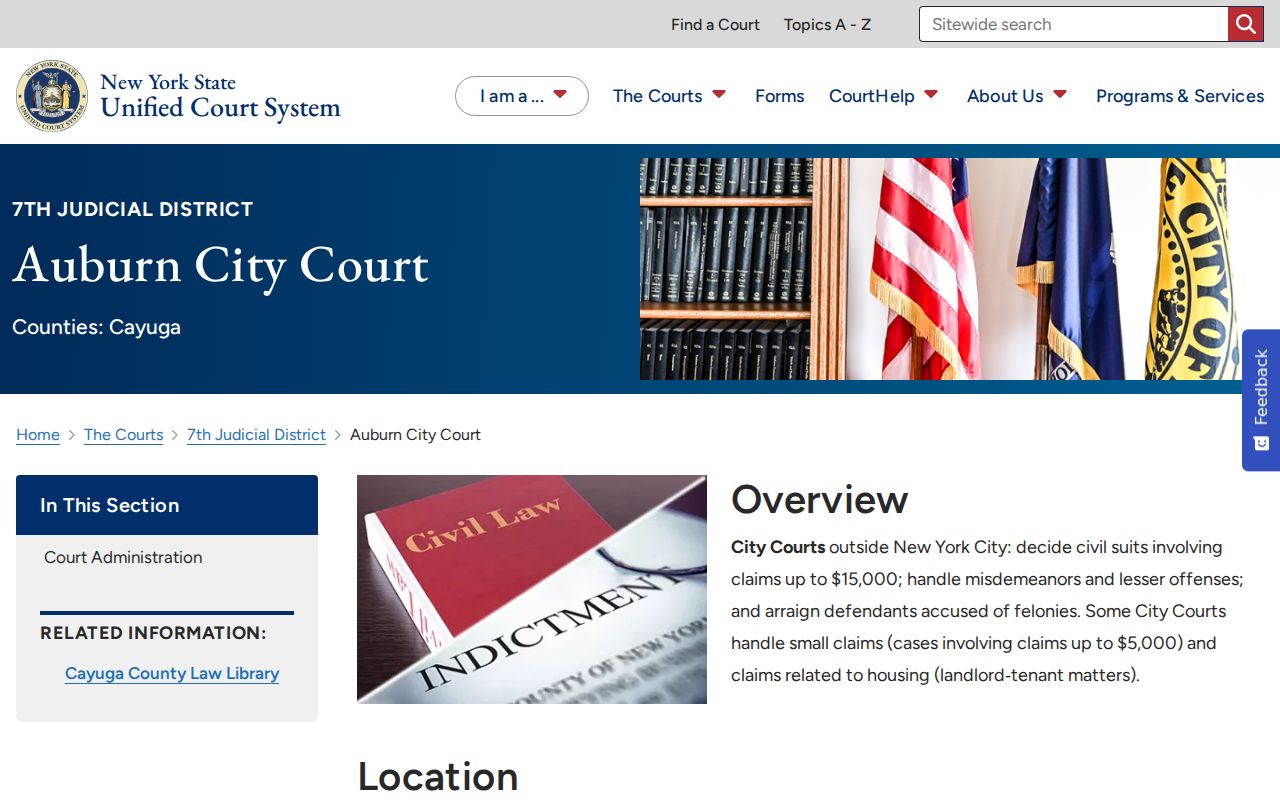
Auburn's court source helps identify the correct clerk before a request is made. It also shows why a city police file and city court file must be checked separately.
| Court Name | Auburn City Court |
|---|---|
| Case Types Heard | Misdemeanors, lesser offenses, and felony arraignments or preliminary proceedings |
| Lookup Channel | City Court clerk; OCA CHRS for a separate statewide exact-name search |
| Docket Content | Charges filed, appearances, motions, pleas, orders, disposition, and sentence when public |
| Certified Outcome | Request a certificate of disposition from the court of conviction |
Auburn Misdemeanor and Felony Records
The Auburn downtown court split can trip up an Auburn search. Auburn City Court handles the local misdemeanor case and begins felony proceedings. Cayuga County Court, at 152 Genesee Street, handles the indicted felony prosecution. The Auburn court buildings are close, but the files remain under different clerks. The accusatory instrument or appearance notice should name the court that currently controls the Auburn matter.
For a final outcome, ask the convicting court for a certificate of disposition. OCA CHRS costs $95 per exact name and date of birth and is not a certified disposition. Published WebCriminal coverage is not comprehensive for Cayuga. If an online screen shows nothing, call the named clerk instead of treating the absence as proof that no Auburn case exists.
Auburn Specialty Court Records
Auburn has named criminal drug treatment, mental-health, veterans-treatment, and domestic-violence parts. The drug treatment and domestic-violence parts are listed through the New York Unified Court System. They remain court proceedings, but treatment details and other protected information do not become fully public merely because a docket exists.
A reader should request the ordinary public docket or disposition from Auburn City Court and let the clerk identify what may be released. Cayuga also has a County Court Drug Treatment Court for felony-level matters. The two drug courts reflect the same city-versus-county division that governs ordinary criminal files. Program participation may shape the case, yet it does not move every document into police custody.
Where Auburn Records End Up
An Auburn arrest can create four connected files. APD owns the local report. Cayuga County Jail owns custody intake if the person is lodged. Auburn City Court owns local proceedings, while County Court controls an indicted felony. Courts report dispositions to OCA and DCJS, and a fingerprintable arrest can feed DCJS earlier in the process.
Record flow: Auburn Police Department › Auburn City Court or Cayuga County Court › New York State Division of Criminal Justice Services
Those systems can disagree for a time. Booking charges may be changed at arraignment, filed charges may change through plea or dismissal, and disposition reporting may lag. Compare your own DCJS cycle with a court certificate when correcting a mismatch. For case-file detail, use the Cayuga County criminal court records route.
Auburn Court Record Access
The court's official accessibility page identifies a street-level entrance on Green Street, elevators to public floors, a first-floor accessible restroom, and public parking on site or next to the building. Accommodation requests should be made several days ahead through the Seventh Judicial District executive office at 585-371-3266, with “ADA Accommodation Request” in the email subject.
This Auburn access channel matters for inspection and clerk-counter requests. A person who cannot use the Auburn public counter should contact the court in advance rather than redirecting the request to APD. The Auburn police bureau and Auburn City Court occupy different buildings, keep different files, and set their own public hours.
Auburn Criminal Record Geography
Auburn is Cayuga County's seat and only city. The 2020 Census counted 26,866 people, while the July 1, 2025 estimate was 25,947. Its 8.34 square miles include the main downtown justice corridor. APD is on North Street, Auburn City Court is at 157 Genesee Street, and County Court is across the record path at 152 Genesee Street.
The jail is not part of that walkable cluster. It stands on County House Road. That physical split mirrors the record split: city report, city case, county felony case, and jail booking can all concern the same event. Auburn's links to Harriet Tubman and William H. Seward are key civic history, but they do not imply anything about current criminal records or crime rates.
Public Access Rules
Police and court access follow different legal routes. Send an APD request under FOIL to the police records access officer. Ask the court clerk for judicial files under court rules and Judiciary Law §255. Sealed cases, youthful-offender adjudications, juvenile matters, grand-jury records, protected victim identities, and parts of active investigations are not open in the same way as an ordinary public disposition.
Key Statutes:
New York Freedom of Information Law sets the request, exemption, and appeal framework for city agency records.
Criminal Procedure Law §160.50 governs sealing after a criminal action ends in the accused's favor.
Criminal Procedure Law §720.35 protects youthful-offender records from ordinary public disclosure.
A denial should be in writing and include appeal instructions. FOIL appeals generally must be made within 30 days. Courts are not executive agencies subject to FOIL in the same manner, so a police FOIL form is not the right form for an Auburn City Court disposition.